The Architectural Wonders of Dolmabahce Palace: A Structural Marvel
Standing gracefully on the European shore of the Bosphorus, Dolmabahce Palace is far more than a residence for sultans; it is a monumental statement of identity, modernization, and artistic ambition. Unlike the sprawling, pavilion-based layout of the Topkapi Palace, Dolmabahce presents a unified, monolithic facade that rivals the great palaces of Europe. For architecture enthusiasts and casual travelers alike, the structure offers a fascinating narrative written in stone, marble, and crystal. It represents a pivotal moment in the 19th century when the Ottoman Empire sought to synthesize its rich eastern heritage with the prevailing western aesthetic trends, creating a unique style often referred to as "Ottoman Baroque."
A Radical Shift in Stylistic Direction
To truly appreciate the architecture here, one must understand the context of its creation. By the mid-19th century, the medieval stone corridors of Topkapi were deemed insufficient for the requirements of modern state protocol. Sultan Abdülmecid I desired a space that reflected the empire's engagement with the West. To understand the full timeline of this transition, delving into the history of the late Ottoman era reveals that this was a cultural revolution as much as a construction project. The architects responsible for this masterpiece were members of the illustrious Balyan family, specifically Garabet Balyan and his son Nigoğayos. They were tasked with a challenge: build a palace that felt European in form but remained Ottoman in function.
The result is an eclectic masterpiece that defies a single categorization. While the general plan preserves elements of the traditional Turkish house—with a central hall surrounding rooms—the execution is a lavish blend of several distinct architectural movements:
- Neoclassical: Evident in the symmetrical columns, triangular pediments, and the sense of order that governs the exterior facade.
- Baroque: Seen in the dramatic curves, heavy ornamentation, and the play of light and shadow on the exterior stonework.
- Rococo: Dominates the interiors with intricate pastel detailing, floral motifs, and an abundance of gold leaf.
- Empire Style: Reflected in the furniture and the grand scale of the reception halls.
The Facade and The Gates: A Grand Entrance
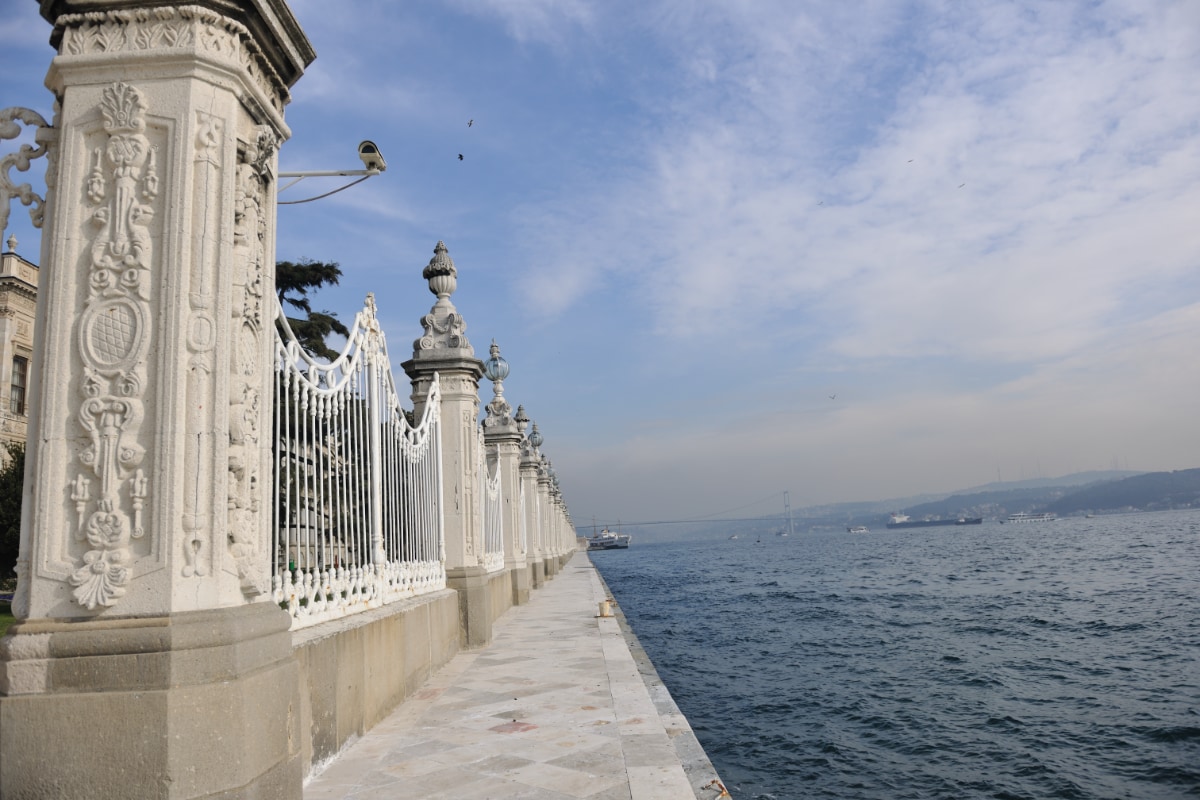
The palace stretches for 600 meters along the Bosphorus, a deliberate design choice to impress visitors arriving by sea. The facade is clad in white marble from the Marmara Island, giving it a gleaming, ethereal quality against the blue waters of the strait. However, the architectural journey begins before one even enters the building. The monumental gates, particularly the Gate of the Treasury and the Imperial Gate, are structural marvels in their own right. These gates are heavily ornamented with high-relief carvings, medallions, and tughras (imperial seals), serving as a prelude to the opulence within. Before planning your approach to these magnificent entrances, it is wise to review the current visiting information to ensure a smooth arrival.
The Crystal Staircase: Engineering Meets Art
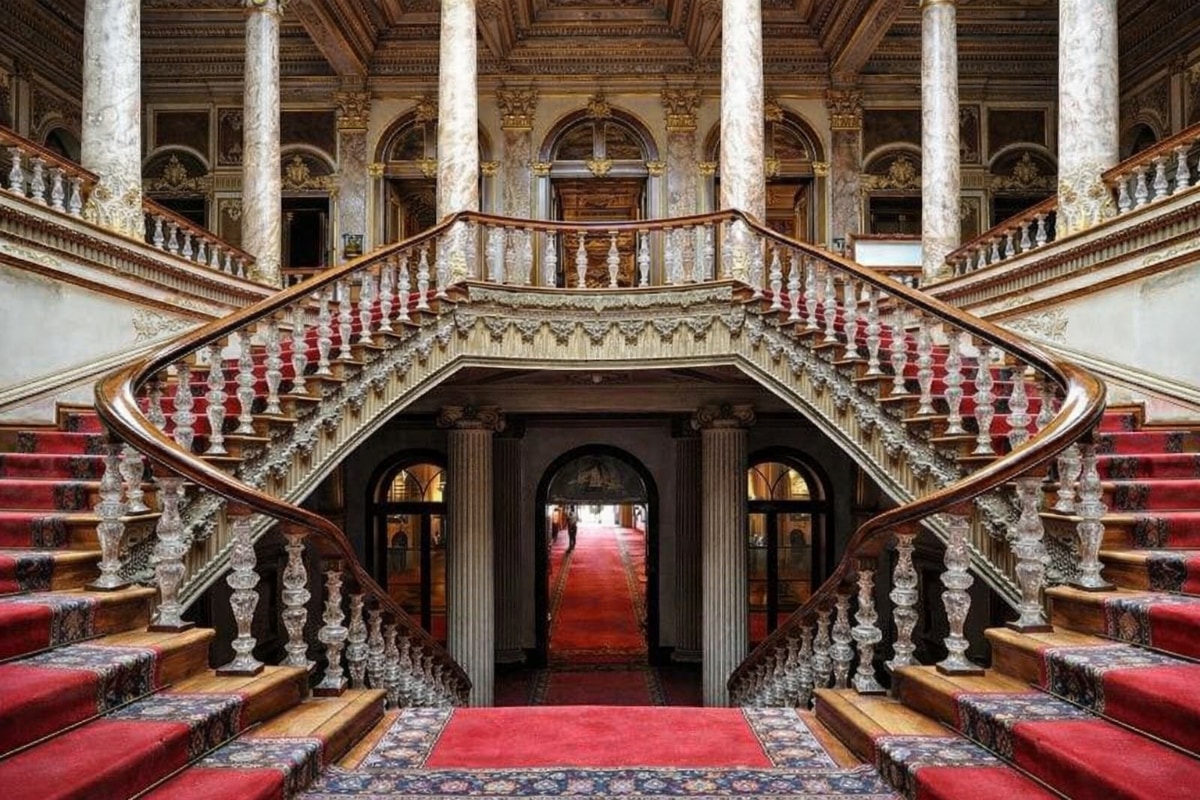
Once inside, the distinct sections of the palace reveal themselves, but few features capture the imagination quite like the Crystal Staircase. This double-horseshoe staircase is a triumph of structural design and decorative art. The balustrade is not made of wood or iron, but of Baccarat crystal, supported by brass and mahogany. The architectural genius here lies in the use of natural light. A glass roof above the staircase allows sunlight to flood the area, refracting through the crystal balusters to create a dazzling prism effect. It was designed to impress dignitaries ascending to the reception rooms, turning a simple act of walking upstairs into a theatrical experience.
The Ceremonial Hall (Muayede Salonu)
The heart of Dolmabahce’s structural prowess is undoubtedly the Muayede Salonu, or the Ceremonial Hall. This vast space, situated between the Harem and the Selamlik (administrative section), is one of the largest palace halls in the world. Architecturally, it is a feat of engineering due to its massive dome, which reaches a height of 36 meters. Unlike traditional Ottoman domes that rest on pendentives, this dome is supported by 56 columns, creating a sense of verticality that draws the eye upward.
The sheer scale of this room required innovative solutions for lighting and heating. The hall houses the world’s largest Bohemian crystal chandelier, a gift from Queen Victoria, weighing a staggering 4.5 tons and holding 750 lamps. Suspending such a weight required a reinforced structural framework hidden within the dome’s intricate interior shell. Furthermore, the heating system was revolutionary for its time, utilizing a hot air blowing system from the basement to warm the colossal volume of air within the hall.
Materials Used in Construction and Decoration
The architects spared no expense in sourcing materials that would ensure both structural integrity and aesthetic perfection. The combination of local resources and imported luxury goods created a unique texture throughout the palace.
| Material | Origin / Type | Usage in Architecture |
| Marble | Marmara Island (Proconnesian) | Exterior cladding, structural columns, and hammam interiors. |
| Crystal | Baccarat (France), Bohemian (Czech), Bessaraba | Chandeliers, balustrades, and mirrors to amplify light and space. |
| Gold Leaf | 14 tonnes of gold used | Adorning ceilings, cornices, and Rococo moldings. |
| Wood | Mahogany, Oak, Ebony | Parquet floors with intricate marquetry and structural framing. |
| Textiles | Hereke Silk and Wool | Massive carpets designed specifically to fit the dimensions of the rooms. |
The Harem: Privacy in Architecture
While the Selamlik was designed to project power and openness, the Harem architecture focuses on privacy without sacrificing luxury. The transition between these zones is seamless yet structurally distinct. The corridors in the Harem are narrower, and the windows are screened with intricate lattices to allow residents to look out without being seen from the outside. This section houses the private quarters of the Sultan, the Queen Mother, and the favorites. The Blue Hall within the Harem is a prime example of how color was used architecturally to create mood; its spacious design served as a gathering place for the royal family during religious festivals. To explore these private quarters, many visitors opt for the combined Dolmabahce Palace & Harem Fast-Track Ticket, which provides access to both the public grandeur and the private intimacy of the complex.
Foundation and Seismic Resilience
Perhaps the most overlooked architectural wonder of Dolmabahce is what lies beneath the surface. The name "Dolmabahce" literally translates to "Filled Garden." The site was originally a bay on the Bosphorus that was gradually filled in during the 17th century to create an imperial garden. Constructing a massive stone palace on reclaimed land posed significant engineering challenges, particularly regarding soil stability and moisture.
To address this, the Balyan architects utilized a foundation technique involving thousands of massive timber piles driven deep into the soil. These mats of timber, submerged in water, petrified over time, providing a rock-solid base for the heavy masonry above. This technique is similar to that used in Venice and has allowed the palace to withstand the seismic activity that frequently affects Istanbul. The resilience of the structure is a testament to the advanced engineering knowledge possessed by the Ottoman builders of the era.
A Legacy in Stone
Dolmabahce Palace stands as a bridge between East and West, not just geographically, but architecturally. It captures a specific moment in time when the Ottoman Empire looked outward, embracing new forms while maintaining its imperial dignity. From the weight-bearing columns of the Muayede Salonu to the delicate crystal of the staircase, every element serves a dual purpose of function and storytelling. Exploring these corridors offers a deep dive into the mind of 19th-century architects who dared to dream on a colossal scale.
Dolmabahçe Palace Today: Today, Dolmabahçe Palace functions as a museum and is carefully preserved as a historical site. Ongoing restoration efforts ensure that the palace's architectural integrity is maintained for future generations. Visitors can witness firsthand the meticulous work being done to conserve the palace's original features, from the intricate gold leaf detailing to the delicate crystal work. The palace also hosts various cultural events and exhibitions, further solidifying its role as a vibrant center for art and history.


