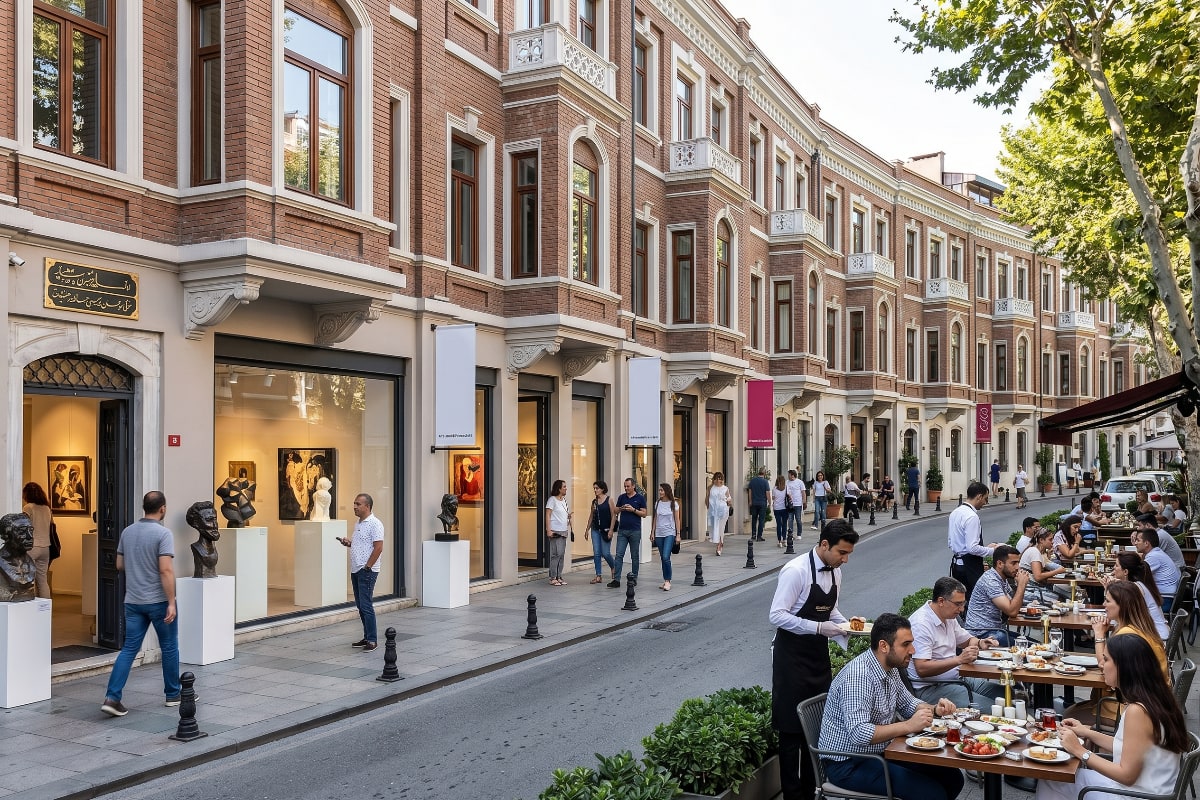
Akaretler Row Houses: Where Palace History Meets Trendy Art and Dining
Istanbul is a city defined by its layers, where every corner reveals a dialogue between the past and the present. Few places exemplify this seamless blend of eras better than the Akaretler Row Houses in Beşiktaş. Walking up the gentle slope from the Bosphorus, you are greeted by a stunning visual rhythm of neoclassical facades that once served a purely functional purpose for the Ottoman court. Today, these historic structures have shed their imperial uniforms to become the beating heart of the city’s contemporary art, fashion, and gastronomy scenes. For the modern traveler, Akaretler offers a unique opportunity to sip third-wave coffee or view avant-garde sculptures within walls that were originally constructed to house the high-ranking staff of the magnificent Dolmabahçe Palace.
The energy here is palpable and distinct from the chaotic buzz of other tourist hubs. It is sophisticated yet accessible, historic yet undeniably hip. As you stroll through this W-shaped architectural marvel, you aren't just window shopping; you are traversing a bridge between the 19th-century lifestyle of the Ottoman elite and the dynamic, creative spirit of 21st-century Istanbul. Whether you are an architecture enthusiast, a foodie, or a history buff, Akaretler provides a culturally rich detour just minutes away from the waterfront.
The Imperial Origins: Housing the Palace Staff
To truly appreciate the vibe of Akaretler, one must understand its prestigious roots. Built in 1875 by Sultan Abdülaziz, these row houses were designed by the renowned Sarkis Balyan, a member of the famous Balyan family of architects who were responsible for many of Istanbul's iconic structures. The primary objective was to provide accommodation for the agas and high-ranking officials working at the nearby Dolmabahçe Palace. Unlike typical staff quarters, these were designed with grandeur and elegance, reflecting the status of the palace they served.
The construction of Akaretler was a significant urban planning milestone for Istanbul. It represented the first residential complex of its kind in the city, introducing the European concept of 'row houses' to the Ottoman capital. If you explore our history page, you will see that the late Ottoman period was defined by this shift towards Western architectural standards, and Akaretler is a prime surviving example of that transition. The name 'Akaretler' itself is derived from the word 'akaret,' meaning real estate or income-generating property, as parts of the complex were intended to generate revenue for the Aziziye Mosque foundation.
Architectural Significance
The layout of the Row Houses is as intriguing as their history. The buildings are arranged in a bifurcated, W-shaped plan that elegantly negotiates the slope of the hill. This design was not merely aesthetic but a clever solution to the topography of the Beşiktaş district. The neoclassical details, the rhythmic fenestration, and the harmonious proportions speak to the genius of Sarkis Balyan. Today, the careful restoration of these buildings has preserved their soul, allowing visitors to touch the same stones that Ottoman officials once brushed past.
Location of Akaretler Row Houses on Google Maps
From Imperial Quarters to a Cultural Hub
The transformation of Akaretler from a residential complex into a luxury destination did not happen overnight. After periods of neglect in the 20th century, a massive restoration project breathed new life into the district. The goal was not to modernize the buildings by stripping away their character, but to repurpose the interiors while meticulously preserving the exterior facades. The result is a district that feels like an open-air museum, yet functions as a modern lifestyle center.
Today, the neighborhood is synonymous with Istanbul's thriving art scene. It is common to find pop-up exhibitions, contemporary art galleries, and cultural events taking over the spaces. Events like Artweeks@Akaretler draw collectors and enthusiasts from around the world, turning the historic street into a vibrant canvas. The juxtaposition is striking: modern abstract art displaying against the backdrop of 19th-century masonry creates a visual tension that is utterly captivating.
| Feature | 19th Century (Ottoman Era) | 21st Century (Modern Era) |
| Primary Purpose | Housing for Palace Agas & Officials | Art, Fashion, and Gastronomy Hub |
| Architectural Style | Neoclassical / Empire Style | Restored Neoclassical with Modern Interiors |
| Residents/Visitors | Imperial Staff and Court Members | Locals, Tourists, Artists, and Foodies |
| Atmosphere | Formal, Imperial, Quiet | Trendy, Vibrant, Artistic, Social |
A Gastronomic Journey in Beşiktaş
Beyond the visual arts, Akaretler has established itself as a premier destination for gastronomy. The row houses are now home to an array of cafes, bistros, and fine-dining restaurants that spill out onto the wide sidewalks. This creates a European boulevard atmosphere where people-watching is just as enjoyable as the food. You can start your day with a traditional Turkish breakfast at a chic cafe, enjoy a light artisan lunch, and transition into the evening with cocktails at a lively bar.
The culinary offerings are diverse, ranging from high-end steakhouses to vegan-friendly eateries and third-wave coffee roasters. What makes dining here special is the setting. There is something uniquely satisfying about enjoying a modern culinary creation while sitting in the shadow of imperial history. For travelers who have spent the morning exploring the vast sections of Dolmabahçe Palace, Akaretler offers the perfect environment to decompress and refuel.
Planning Your Visit: The Perfect Itinerary
Akaretler is best experienced as part of a broader exploration of the Beşiktaş district. Because of its location, it serves as a natural extension to a visit to the waterfront palaces. A recommended itinerary involves starting your day early at the palace to avoid the crowds. We highly recommend purchasing a Dolmabahce Palace & Harem Fast-Track Ticket beforehand to maximize your time. After immersing yourself in the opulence of the Sultan's residence, walk towards the Naval Museum.
The Naval Museum (Deniz Müzesi) is located right at the foot of the Akaretler slope and houses an impressive collection of Ottoman caiques (imperial boats). From there, simply cross the street and begin your ascent into Akaretler. The walk is gentle, and the changing perspective of the Bosphorus as you go up is delightful. For more practical details on opening hours and transportation, be sure to check our visiting information page.
Highlights Not to Miss
- The W-Shaped Layout: Take a moment to stand at the bottom of the hill to appreciate the unique architectural footprint of the complex.
- Art Galleries: Pop into the various galleries nestled within the row houses; admission is usually free and the art is world-class.
- Mustafa Kemal Atatürk’s Residence: It is a little-known fact that the founder of the Turkish Republic, Mustafa Kemal Atatürk, briefly lived in one of these houses (Number 76) with his mother and sister.
- Coffee Culture: The neighborhood is famous for its coffee shops. Grab a latte and sit outside to soak in the local fashion and energy.
Conclusion
Akaretler Row Houses represent the resilience and adaptability of Istanbul. They stand as a testament to a time when the Ottoman Empire was looking Westward, and today, they continue to look forward as a beacon of culture and style. It is a place where the grandeur of history provides the stage for the vibrancy of modern life. Whether you are coming for the architecture, the art, or simply a good meal after a day of sightseeing, Akaretler welcomes you with a charm that is impossible to replicate.


