Architectural Influences: The International Styles Shaping Dolmabahçe
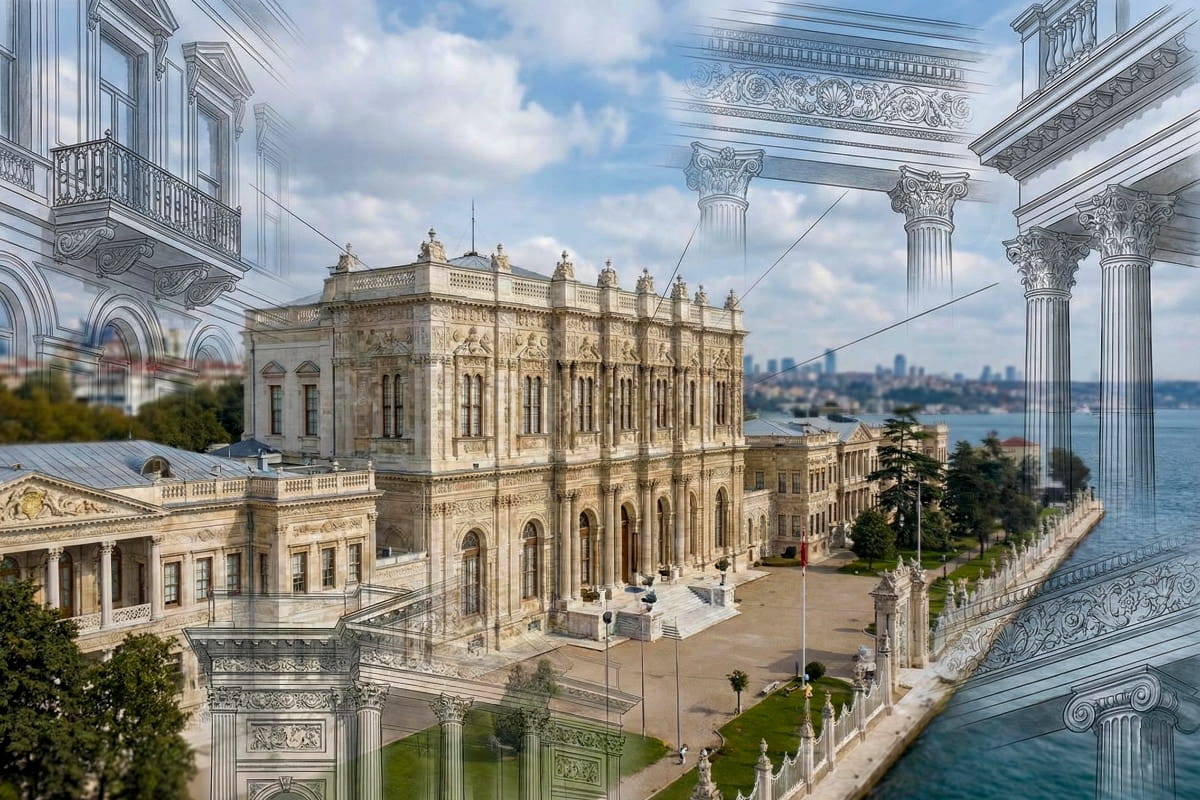
Standing on the European shore of the Bosphorus, Dolmabahçe Palace is far more than a residence of sultans; it is a monumental statement of transformation. Unlike the sprawling, pavilion-based layout of the Topkapı Palace, which reflected the nomadic and distinctively Eastern roots of the early Ottoman Empire, Dolmabahçe was built to announce the empire's modernization to the world. For the traveler standing before its imposing white marble façade, the palace offers a visual narrative of the 19th century—a time when Istanbul was actively bridging the gap between East and West. The result is not merely a copy of European palaces, but a unique synthesis that redefined Ottoman identity through stone, crystal, and gold.
The Great Shift: From Topkapı to the Bosphorus
To understand the architecture of Dolmabahçe, one must first understand the mindset of Sultan Abdülmecid I. By the mid-19th century, the medieval stone corridors of Topkapı were deemed insufficient for the ceremonial needs of a modernizing state. The Sultan desired a residence that could rival the lavish courts of France, Austria, and England. This desire necessitated a departure from traditional Ottoman architecture, leading to a grand experiment in style. However, the transition was not about abandoning identity but rather evolving it. If you look closely at the history of the site, you will see that the location itself—a filled-in bay that once served as an imperial garden—dictated a linear, seaside layout that is quite different from the enclosed courtyards of the past.
A Symphony of Styles: The Eclectic Façade
Dolmabahçe is frequently categorized under the umbrella of "Ottoman Eclecticism." This term refers to the free mixing of various European architectural movements, primarily Baroque, Rococo, and Neoclassical, all adapted to suit Ottoman tastes. The architects, members of the illustrious Armenian Balyan family, were educated in Europe but deeply rooted in Istanbul culture, allowing them to weave these disparate threads together seamlessly.
The Baroque Influence
The most dominant visual language in the palace is undoubtedly Baroque. This style, characterized by drama, movement, and grandeur, is evident the moment you approach the Imperial Gate. The heavy ornamentation, the play of light and shadow on the stone carvings, and the sheer theatricality of the entrance are distinctively Baroque. Inside, this influence reaches its peak in the design of the staircases and the grand ceremonial halls.
Rococo and Neoclassical Touches
While the heavy lifting is done by Baroque elements, the delicate details often whisper in Rococo. This is particularly visible in the interior decorations, the ceiling frescoes, and the intricate garlands adorning the walls. In contrast, the Neoclassical influence provides a sense of order and symmetry, particularly in the colonnades and the rhythmic arrangement of the windows along the sea façade. This blend ensures that while the palace is ornate, it maintains a majestic dignity rather than becoming visually chaotic.
The Ottoman Soul Within a European Shell
Perhaps the most fascinating aspect of Dolmabahçe’s architecture is that despite its Western appearance, the internal organization remains faithfully Ottoman. The palace is not arranged like a European palace with interconnected salons for mixed-gender socializing. Instead, it strictly adheres to the traditional separation of private and public life.
- The Selamlık (Mabeyn-i Hümayun): This is the administrative heart of the palace, designed for state affairs, male visitors, and official ceremonies. It is the most "Western" in decoration, intended to impress foreign dignitaries.
- The Harem-i Hümayun: Connected yet distinct, the Harem was the private residence of the Sultan and his family. Here, the architecture turns inward, focusing on privacy and domestic hierarchy.
- The Muayede Salonu (Ceremonial Hall): Situated between the two, this massive hall acts as the bridge, soaring high above the rest of the structure.
Visitors exploring the different sections of the palace will notice this functional division. The exterior presents a unified, continuous European façade, masking the culturally specific segregation of space occurring within. This duality is the genius of the Balyan architects—creating a building that looks Western to the world but functions as an Ottoman home.
Key Architectural Highlights to Look For
When walking through the corridors, it is easy to be overwhelmed by the sheer amount of gold and crystal. However, focusing on specific architectural elements can reveal the depth of the design.
| Architectural Element | Style Influence | Why It Matters |
| The Crystal Staircase | Baroque / British Industrial | The horseshoe shape is classic Baroque drama, but the use of Baccarat crystal balusters introduces a modern, industrial luxury unique to the era. |
| The Muayede Hall Dome | Neoclassical Engineering | This massive dome, supported by 56 columns, showcases advanced engineering disguised by artistic grandeur. It was designed to hold the world's largest Bohemian crystal chandelier. |
| The Gates (Gate of the Treasury) | Ottoman Baroque | These gates are sculptural masterpieces. They feature excessive ornamentation that surpasses European norms, creating a distinct "Istanbul Baroque" flavor. |
| The Bathhouses (Hamams) | Traditional Ottoman | Despite the European bedrooms, the bathing facilities remain traditional Turkish Hamams, utilizing Egyptian alabaster and local marble. |
The Role of the Balyan Family
No discussion of Dolmabahçe’s architecture is complete without acknowledging the Balyan family. Karabet Balyan and his son Nigoğayos were the masterminds behind this project. Their education in Paris allowed them to bring authentic European techniques to Istanbul, but their local knowledge ensured the palace could withstand the humid Bosphorus climate and meet the Sultan's specific needs. They were not just copying plans; they were interpreting a cultural shift. Their work established a specific "Bosphorus Style" that influenced mansions and public buildings throughout the late Ottoman period.
Practical Tips for the Architecture Enthusiast
To truly appreciate the architectural nuances of Dolmabahçe, planning your visit is essential. The palace is vast, and the details are dense. Since the daily visitor capacity is limited to preserve these architectural wonders, it is highly recommended to secure your entry in advance. You can find options for a Dolmabahce Palace & Harem Fast-Track Ticket to ensure you have ample time to study the intricate ceilings and the grand façade without the stress of long queues.
Furthermore, remember that the lighting changes the perception of the architecture. The morning light hitting the sea façade emphasizes the Neoclassical symmetry, while the afternoon sun often highlights the depth of the Baroque carvings on the land-side gates. For comprehensive details on opening hours and best times to visit, checking the visiting information is always a smart move before heading out.
A Legacy in Stone
Dolmabahçe Palace is more than a building; it is a frozen moment in time where an empire looked westward with hope and ambition. The synthesis of the heavy Baroque, the playful Rococo, and the disciplined Neoclassical, all wrapped around a traditional Ottoman core, creates an architectural language that exists nowhere else on earth. As you walk through its halls, you aren't just seeing luxury; you are witnessing the physical manifestation of a bridge between cultures—a legacy that continues to captivate visitors from around the globe.
References:
- Shaw, Stanford J. History of the Ottoman Empire and Modern Turkey. Cambridge University Press, 1976.
- Mansel, Philip. Constantinople: City of the World's Desire, 1453-1924. St. Martin's Griffin, 1998.
- Sakaoğlu, Necdet. Bu Mülkün Sultanları. Oğlak Yayıncılık, 2015.


